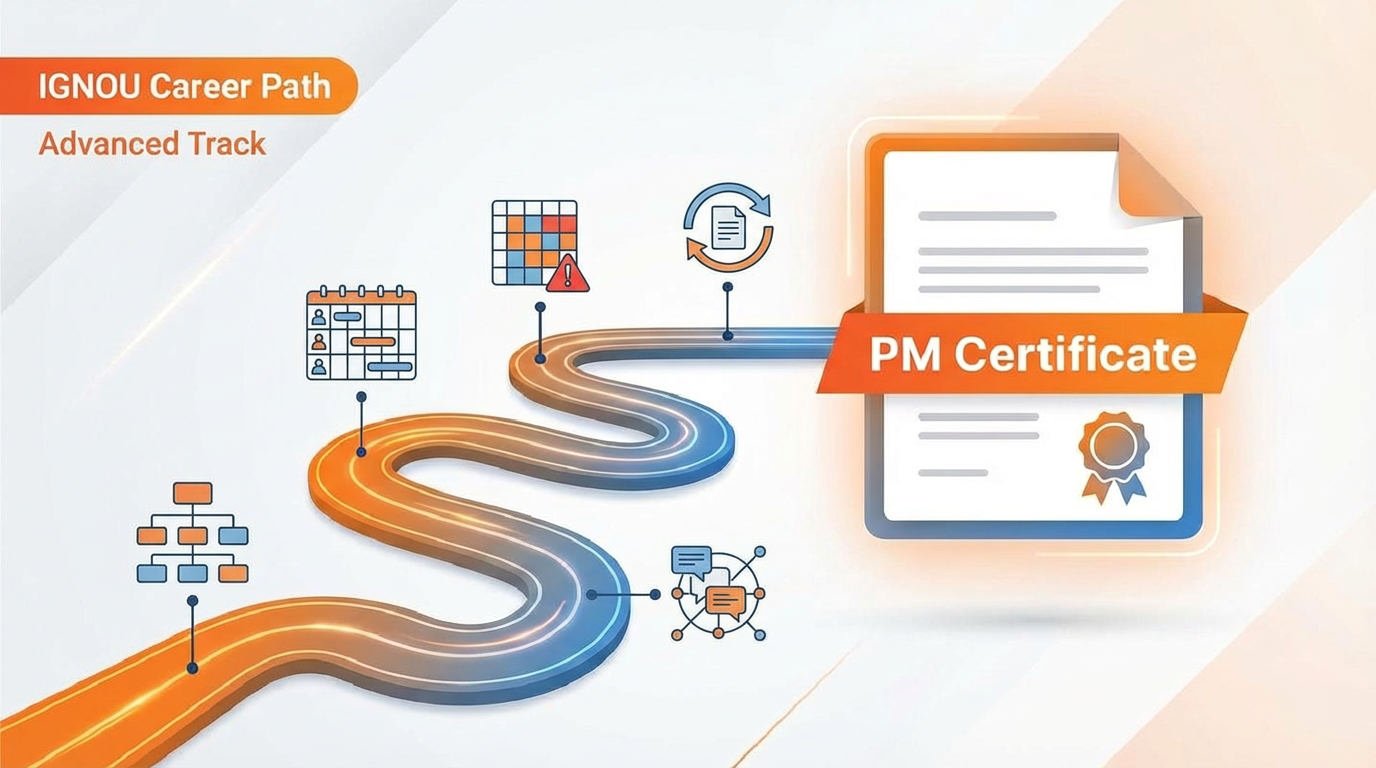
The simplest path that works for most people
The simplest path that works for most advanced learners
-
Confirm Track 2 baseline
Ensure you already have: integrated plan pack + execution pack + change log + decision log + variance summary.
-
Choose one senior credential direction
Select one: PMP (leadership), PRINCE2 Practitioner (governance), PgMP (programs), or PMI-RMP (risk).
-
Build a stakeholder reporting workspace
Create dashboards, baselines/variance views, and a weekly reporting system in one tool ecosystem.
-
Publish 2 advanced case studies
Each case study must show decisions, trade-offs, change control, and outcomes (not just templates).
-
Apply or pursue promotion with proof
Use one portfolio link. Your case studies are the “leadership evidence” recruiters trust.
Project Management Career Path (Advanced) — Track 3
This track is for learners who want promotion-ready proof. You’ll build executive-level case studies, strengthen governance and delivery control (variance + change + decisions), and choose one senior credential direction (PMP/PRINCE2/PgMP/Risk). The goal is not “more courses”—it is a portfolio that shows leadership and outcomes.
Fast facts
- Level: Advanced (Track 2 completed)
- Time: Fast 10–12 weeks • Standard 14–20 weeks • Busy 4–8 months
- Weekly effort: 5–12 hrs/week (plus optional exam prep time)
- Core output: Stakeholder Reporting Workspace + 2–3 advanced case studies
- Credentials: Choose ONE main senior branch (PMP/PRINCE2/PgMP/Risk)
- Target roles: Project Manager, Senior PM (path), PMO, Program delivery (junior–mid)
Jump to
Who this is for
- Track 2 completers who want promotion-ready proof, not more beginner certificates.
- Working coordinators / junior PMs who already run parts of delivery and want stronger leadership credibility.
- PMO-oriented learners who want dashboards, governance, and portfolio-level reporting signals.
- Credential-focused professionals who want one senior credential direction chosen intelligently.
Time required (realistic estimates)
- Fast track: 10–12 weeks (10–12 hrs/week) — tool workspace + 2 case studies (no exam focus).
- Standard pace: 14–20 weeks (6–10 hrs/week) — most learners, best quality output.
- Busy schedule: 4–8 months (4–6 hrs/week) — steady progress without burnout.
Optional add-ons (only if you choose them)
- PMP exam prep: +8–16 weeks (varies by background)
- PRINCE2 Practitioner prep: +4–10 weeks
- Agile credential (PSM II or SAFe): +2–6 weeks
Outcomes (what you can do after this track)
- Lead delivery with change control, decision trails, and stakeholder governance.
- Build executive-ready dashboards and reporting cadence inside one tool ecosystem.
- Explain variance (schedule/cost/scope) and corrective actions with confidence.
- Publish 2–3 advanced case studies that show leadership, trade-offs, and outcomes.
- Select one senior credential direction with clarity (PMP/PRINCE2/PgMP/Risk) and avoid redundant stacking.
Prerequisites
- Track 2 completed: you should have an integrated plan pack + execution pack + change log + decision log.
- Comfort with reporting: status cadence, stakeholder updates, RAID ownership.
- Some real-world exposure (helpful): internship/work project/volunteer delivery cycle.
- Willingness to publish proof: 2–3 case studies that show decisions and outcomes.
Tools you’ll use
- Project ecosystem (choose one): Jira OR MS Project OR Smartsheet (advanced dashboards + variance).
- Spreadsheets: Excel/Sheets (variance tables, trackers, benefits snapshot).
- Docs: decision logs, change requests, governance notes, case studies.
- Portfolio home: one clean page/folder that a recruiter can scan in 60 seconds.
Roadmap
Step 1: Confirm your baseline (required)
This track assumes you already finished the Intermediate Track and can show control, governance, and measurable outcomes.
- If you don’t have Intermediate proof yet: Complete the Intermediate Track first
- Must-have proof: integrated plan pack + execution pack + change log + decision log + variance summary + stakeholder-ready reporting
Deliverable: an “Advanced Baseline Pack” (exec-ready evidence you can lead delivery).
Step 2: Senior credential branch (choose ONE)
Pick one main credential direction and build evidence around it. Use optional prep resources only if you want structured study and mock exams.
-
Option A (project leadership):
PMP (PMI)
- Authority prep: PMP Exam Preparation (PMI)
- Optional enhanced prep (listed below): PMP Exam Prep Certification Training (Coursera Specialization)
-
Option B (governance-heavy environments):
PRINCE2 7 Practitioner (PeopleCert)
- Optional enhanced prep (listed below): PRINCE2 7th Edition: Foundation & Practitioner (Udemy)
-
Option C (program leadership):
PgMP (PMI)
- Optional enhanced prep (listed below): Program Management Professional Certification Prep (Coursera Specialization)
- Optional support (listed below): Microsoft Program Management Professional Certificate (Coursera)
-
Option D (risk specialization):
PMI-RMP (PMI)
- Optional enhanced prep (listed below): Risk Management Professional Certification Prep (Coursera Specialization)
Deliverable: a “Credential Readiness Plan” (target date + study plan + mapped proof from real projects).
Step 3: Agile leadership (choose ONE to avoid redundancy)
Choose one agile direction aligned to your target jobs. If you already have SAFe Agilist or PSM II, PMI-ACP may be redundant unless job postings explicitly require it.
-
Option A (Scrum mastery):
PSM II (Scrum.org)
- Optional practice (listed below): PSM II Practice Exams (Udemy)
-
Option B (enterprise agile at scale):
SAFe Agilist (Scaled Agile)
- Optional practice (listed below): Leading SAFe Agilist Practice Exams (Udemy)
-
Option C (PMI agile practitioner):
PMI-ACP (PMI)
- Authority prep: PMI-ACP Exam Prep (PMI)
- Optional enhanced prep (listed below): PMI-ACP Exam Prep (Coursera Specialization)
Deliverable: an “Agile Leadership Pack” (cadence + metrics + facilitation proof + improvement plan).
Step 4: Tool mastery (advanced reporting + control)
Choose one tool ecosystem and build executive-ready reporting (dashboards, baselines/variance, automation).
-
Option A (Agile/tech): Jira advanced
- Optional enhanced course (listed below): Jira Advanced | Administration & JQL for Power Users (Udemy)
-
Option B (Corporate/ops): Microsoft Project advanced
- Optional enhanced course (listed below): Microsoft Project Advanced: Top Level Project Management (Udemy)
-
Option C (Cross-functional ops): Smartsheet advanced
- Optional enhanced course (listed below): Smartsheet Project Management – Intermediate to Advanced (Udemy)
-
Option D (portfolio-level scaling):
Lean Portfolio Management (SAFe)
- Optional practice (listed below): SAFe LPM Exam Simulator (Udemy)
Deliverable: one “Stakeholder Reporting Workspace” (dashboards + cadence + variance + decision trail).
Step 5: Advanced portfolio (executive-level proof)
At this level, your portfolio must show outcomes, governance, and trade-offs—not just templates.
- Case study 1 (complex delivery): baseline → change control → variance story → outcome
- Case study 2 (stakeholder governance): decisions + comms cadence + conflict/constraint management
- Case study 3 (scale): program/portfolio view + prioritization + benefits logic (if applicable)
Deliverable: 2–3 advanced case studies + a concise “governance + outcomes” narrative for interviews.
Optional: Advanced project management prep courses, tool deep-dives, and practice tests (paid)
Optional add-ons for learners who want a guided format. Use these to accelerate exam prep (PMP / PRINCE2 / PMI-ACP), strengthen delivery tool mastery (Jira / Microsoft Project / Smartsheet), or validate readiness with practice tests. The actual course links are in the Recommended Courses section.
Exam prep (advanced credentials)
- PMP exam prep: PMP Exam Prep Certification Training (Coursera Specialization)
- PgMP exam prep: Program Management Professional Certification Prep (Coursera Specialization)
- PMI-ACP exam prep: PMI-ACP Exam Prep (Coursera Specialization)
- Risk management (PMI-RMP-aligned): Risk Management Professional Certification Prep (Coursera Specialization)
- PRINCE2 7 (Foundation + Practitioner): PRINCE2 7th Edition: Foundation & Practitioner (Udemy)
Tool mastery (advanced delivery reporting)
- Jira advanced (JQL + admin + dashboards): Jira Advanced | Administration & JQL for Power Users (Udemy)
- Microsoft Project advanced (baselines + critical path): Microsoft Project Advanced: Top Level Project Management (Udemy)
- Smartsheet advanced (dashboards + automation): Smartsheet Project Management – Intermediate to Advanced (Udemy)
Practice exams / simulators (optional)
- PSM II practice tests: PSM II Practice Exams (Udemy)
- SAFe Agilist practice tests: Leading SAFe Agilist Practice Exams (Udemy)
- SAFe LPM simulator: SAFe LPM Exam Simulator (Udemy)
Portfolio (Advanced Leadership Pack)
Your portfolio must demonstrate leadership signals: governance, trade-offs, outcomes, and consistent control over time.
1) Stakeholder Reporting Workspace
- Dashboards (progress + risk + milestones)
- Baseline + variance view (schedule and/or cost)
- Weekly reporting cadence (status format + distribution logic)
- Decision log + change control trail
2) Advanced Case Studies (2–3)
- Each includes: context, goal metrics, constraints, key decisions, change events, variance explanation, outcome.
- Each links to supporting artifacts (plan pack, reporting history, change requests).
3) Optional credential alignment
- Add a short “credential plan” note (target, eligibility, timeline) if you are pursuing PMP/PRINCE2/PgMP/Risk.
Portfolio Rubric (Advanced Quick Check)
Tick these items to confirm your portfolio shows leadership, governance, and outcomes at an advanced level.
1) Stakeholder Reporting Workspace
- Dashboards exist: progress + milestones + risk/RAID are visible at a glance.
- Baseline + variance exists: shows “planned vs actual” (schedule and/or cost).
- Reporting cadence exists: weekly status format + consistent update rhythm.
- Decision log exists: decisions have date, owner, rationale, and follow-up action.
- Change trail exists: changes have impact, decision, and outcome recorded.
- Stakeholder-ready: views are readable, minimal, and understandable in 60 seconds.
2) Advanced Case Studies (2–3)
- Each has metrics: goal + measurable success criteria (time/cost/quality/scope or KPI).
- Each shows constraints: assumptions, dependencies, and trade-offs are explicit.
- Each shows leadership decisions: at least 2 key decisions with rationale.
- Each includes change/variance: what changed + impact + corrective action.
- Each links evidence: dashboards + plan pack + reporting history + change requests.
- Each ends with learning: what you’d repeat, what you’d change, and why.
3) Optional credential alignment (only if pursuing)
- One credential direction: chosen branch is clear (PMP / PRINCE2 / PgMP / Risk).
- Timeline exists: target date + weekly study plan.
- Eligibility is realistic: you meet (or are tracking) requirements.
Final “Promotion Ready” Test
- You can present a case study in 3 minutes (context → decision → outcome → metrics).
- You can explain variance without defensiveness (root cause + action).
- You can explain how you managed stakeholders (cadence + decisions + escalation).
- Your portfolio link is clean and scannable (one page/folder, clear headings).
Proof-of-work templates
Advanced proof is leadership and outcomes: executive communication, governance maturity, and measurable delivery impact. Fill the inputs, then copy the output.
Resume bullet builder (Project leadership)
Fill these inputs:
- Initiative: [name + business area]
- Scope: [teams/functions involved]
- Governance: steering updates + decision trail + change control
- Impact: [metric improved / cost avoided / cycle time reduced / adoption increased]
Copy/paste output:
Led cross-functional delivery for [initiative] across [teams] by implementing executive-ready reporting, decision governance, and change control; improved [metric] by [X%/X] and delivered [outcome] while managing critical dependencies and stakeholder trade-offs.See a real example
Led cross-functional rollout planning across IT and operations by implementing steering updates, decision governance, and change control; improved delivery predictability and reduced last-minute scope changes by formalizing approval and escalation paths.
Steering committee update (one-pager)
Rule: One screen only. Leaders want: risks, decisions, forecast.
Copy/paste output:
Initiative: [name] | Period: [date range] | Status: [Green/Amber/Red]
Objective: [business outcome] | KPIs: [KPI 1], [KPI 2]
Progress: [1–2 bullets]
Top risks/issues: [risk 1 + mitigation + owner] | [risk 2 + mitigation + owner]
Decisions needed: [decision 1] | [decision 2]
Change summary: [#] changes | net impact: [+/- time/cost/scope]
Forecast: next milestones [A/B] | confidence: [High/Med/Low]
Ask: [what you need leadership to approve/remove]
See a real example
Status: Amber. Decision needed: approve scope trade-off to protect timeline. Change summary: 2 changes approved (+1 week net). Ask: assign owner for external dependency escalation.
Interview answer (leadership + trade-offs)
How to use: Lead with a decision moment and your governance response.
Copy/paste output:
I led [initiative] with [teams/stakeholders] and success metrics of [KPIs].
I set governance (cadence, owners, escalation) and delivered executive-ready reporting with a decision and change trail.
A critical moment was [risk/issue/change] threatening [scope/time/cost], so I presented options with impact trade-offs.
I aligned stakeholders, secured a decision, updated baselines, and kept delivery transparency through consistent reporting.
The outcome was [result], and it improved [metric] while reducing future delivery risk via [process/governance improvement].
See a real example
I led a cross-functional initiative and ran steering updates with a decision/change trail. When a dependency delay threatened the timeline, I presented options with schedule impacts, secured approval, re-baselined milestones, and maintained transparent reporting. The outcome was controlled scope, predictable delivery, and improved stakeholder alignment.
Recommended Courses (Optional, Guided Learning)
Use these add-ons if you want a guided format for exam prep, tool mastery, or practice tests. Always prioritize real project evidence (case studies, governance trail, measurable outcomes) alongside study.
Exam prep (advanced credentials)
PMP Exam Prep Certification Training (Coursera Specialization)
Best guided option when you are experience-eligible and want structured PMP preparation with a steady weekly pace.
PgMP: Program Management Professional Exam Prep (Coursera Specialization)
Choose this if you operate above single-project scope: multiple projects, benefits delivery, governance, and program-level control.
PMI-ACP Exam Prep (Coursera Specialization)
Only pick this if your target roles explicitly ask for PMI-ACP or your employer prefers PMI-branded agile. If you already hold SAFe/PSM credentials, it may be redundant.
Risk Management Certification Prep (Coursera Specialization)
Best for advanced delivery control: risk identification, qualitative/quantitative methods, response planning, and governance-ready risk reporting.
Tool mastery (advanced delivery reporting)
Jira Advanced 2025: Administration & JQL for Power Users (Udemy)
Upgrade if you need advanced Jira reporting, workflows, permissions, and automation for stakeholder-ready delivery.
Microsoft Project Advanced: Top Level Project Management (Udemy)
For corporate/ops delivery: baselines, dependencies, variance reporting, and advanced schedule control.
Smartsheet Project Management: Intermediate to Advanced (Udemy)
Best if you run cross-functional operations: dashboards, workflows, and stakeholder-ready status automation.
Governance (PRINCE2 pathway support)
PRINCE2 7th Edition: Foundation & Practitioner 2025 (Udemy)
Best if your target employers value PRINCE2 governance. Focus on tailoring, management products, and practitioner-style scenario thinking.
Practice exams / simulators (optional)
SAFe Agilist 6.0 Certification Prep: Practice Exams (Udemy)
Optional practice layer if you’re preparing for SAFe Agilist. Use it to test readiness after you learn the framework.
SAFe Lean Portfolio Manager LPM Exam Simulator 6.0 (Udemy)
Optional practice layer if you’re targeting portfolio/PMO strategy roles in SAFe-heavy organizations.
Professional Scrum Master II (PSM II) Practice Tests (Udemy)
Optional practice if you’re pursuing PSM II. Use practice tests to expose gaps in facilitation, coaching, and advanced Scrum application.
Common Advanced Mistakes (and how to avoid them)
1) Credential stacking without a leadership narrative
Fix: choose ONE main credential direction (PMP or PRINCE2 or PgMP or Risk). Your portfolio should prove leadership regardless of the badge.
2) Publishing “templates” instead of outcomes
Fix: advanced portfolios must show metrics, trade-offs, decisions, and results. Artifacts are evidence, not the headline.
3) Hiding variance (or explaining it poorly)
Fix: show planned vs actual and explain: root cause → decision → corrective action → outcome. Senior interviewers expect variance.
4) No decision trail
Fix: maintain a decision log with date, owner, rationale, and follow-up. This is a leadership signal recruiters trust.
5) “Agile certification overload” (redundant choices)
Fix: pick ONE agile leadership direction: Scrum (PSM II) OR SAFe (Agilist/LPM) OR PMI-ACP. Only add another if job postings demand it.
6) Tool mastery focused on features, not stakeholder communication
Fix: build an executive-ready workspace: dashboards, baselines/variance, automated reporting, and a consistent cadence.
7) Case studies that are too long (nobody reads them)
Fix: keep each case study 1–2 pages with clear headings: context, metrics, constraints, decisions, changes, outcomes, lessons.
8) Choosing the wrong “advanced project” (too vague or unrealistic)
Fix: pick a project with real constraints: fixed deadline, stakeholder conflict, dependencies, or budget limits. Complexity must be believable.
9) Not aligning your proof to target roles
Fix: PM roles want delivery control; PMO wants governance and reporting; program roles want benefits and prioritization. Tailor your case studies accordingly.
10) Applying as “Senior” without promotion-ready stories
Fix: prepare stories on escalation, negotiation, change control, stakeholder alignment, and leading recovery from delays.
Why Students Choose This Career Path (Advanced Track)
1) It is promotion-oriented, not certificate-oriented
Track 3 is designed for learners who want senior credibility. The main output is executive-ready proof: stakeholder reporting, governance, and outcomes—not “more course completions.”
2) It produces 2–3 leadership case studies that show outcomes
Advanced interviews focus on results and trade-offs. This track builds case studies that include metrics, constraints, key decisions, change events, variance explanations, and outcomes—exactly what senior hiring panels look for.
3) It creates a real stakeholder reporting workspace
You build dashboards, baseline/variance views, and a reporting cadence inside one tool ecosystem. This demonstrates that you can run governance and reporting at a professional level.
4) It prevents credential redundancy (choose one main branch)
Advanced learners often waste time stacking overlapping credentials. Track 3 forces clarity: choose one senior direction (PMP, PRINCE2 Practitioner, PgMP, or risk specialization) and align your proof around it.
5) Agile leadership is optional and non-redundant
If your target roles require agile leadership, you choose one aligned path (Scrum mastery or scaled agile). The track avoids unnecessary overlap so your time stays focused and realistic.
6) It matches how senior PMs are evaluated (governance + decisions + control)
Senior roles are judged on decision-making, stakeholder management, and control of change and variance. This track builds those signals into your portfolio intentionally.
7) It makes your portfolio easy to scan in 60 seconds
Recruiters and hiring managers skim. Track 3 emphasizes a clean portfolio link with scannable headings, consistent naming, and proof that is easy to verify quickly.
FAQs (Project Management Career Path — Advanced Track)
1) Do I need to complete the Intermediate Track before Track 3?
Yes. Track 3 assumes you already have an Integrated Plan Pack + Execution Pack (baselines, reporting history, change log, decision log, variance summary). Advanced work builds on those control signals.
2) What is the main goal of the Advanced Track?
The goal is promotion-ready proof: executive-level reporting, decision trails, change control maturity, and 2–3 advanced case studies that show outcomes and leadership—not just templates.
3) Which “senior credential branch” should I choose: PMP, PRINCE2 Practitioner, PgMP, or PMI-RMP?
Choose based on target roles and environment. PMP fits general project leadership where employers value PMI. PRINCE2 Practitioner fits governance-heavy environments (common in UK/EU/public sector). PgMP is for program leadership across multiple projects. PMI-RMP is for risk-focused differentiation. Most learners should pick one main branch to avoid redundancy.
4) I am not eligible for PMP yet. Can I still do Track 3?
Yes. Track 3 is not “PMP prep only.” You can build advanced portfolio proof and stakeholder reporting now, and pursue PMP later when you meet PMI’s experience requirements.
5) Is PMI-ACP redundant if I already plan SAFe Agilist or PSM II?
Often, yes. If your target employers want SAFe, choose SAFe Agilist. If they want Scrum leadership, choose PSM II. Choose PMI-ACP mainly when job postings explicitly request it or your organization prefers PMI-branded agile credentials.
6) What should an “advanced case study” include?
Each advanced case study should include: context, measurable success criteria, constraints, key decisions, at least one change/variance event with impact notes, corrective action, and outcome. Link to dashboards, reporting history, and change/decision logs.
7) What is a “Stakeholder Reporting Workspace” in practice?
It is one tool ecosystem (Jira, MS Project, or Smartsheet) configured with dashboards, baselines/variance views, a weekly reporting cadence, and a decision + change trail. It should be understandable to a stakeholder in under 60 seconds.
8) How long does Track 3 take realistically?
The core track usually takes 14–20 weeks at a standard pace. Faster learners can complete the portfolio build in 10–12 weeks. Credential exam prep is optional and may add additional weeks depending on the certification.
9) What jobs does Track 3 support?
Track 3 supports applications and promotion paths toward Project Manager, Senior PM (path), PMO, and program delivery roles—because it proves governance, leadership decisions, and outcome-based reporting.
10) Do I need 3–5 years of experience to benefit from this Advanced Track?
No. Experience is required for some credentials (like PMP), but you can still build advanced proof using internships, volunteering, student projects, and cross-functional initiatives. Track 3 is about leadership evidence and delivery control signals.
Related learning paths
Next steps
Block your first 30-minute session this week and complete the Start Week 1 milestone.
Start Week 1