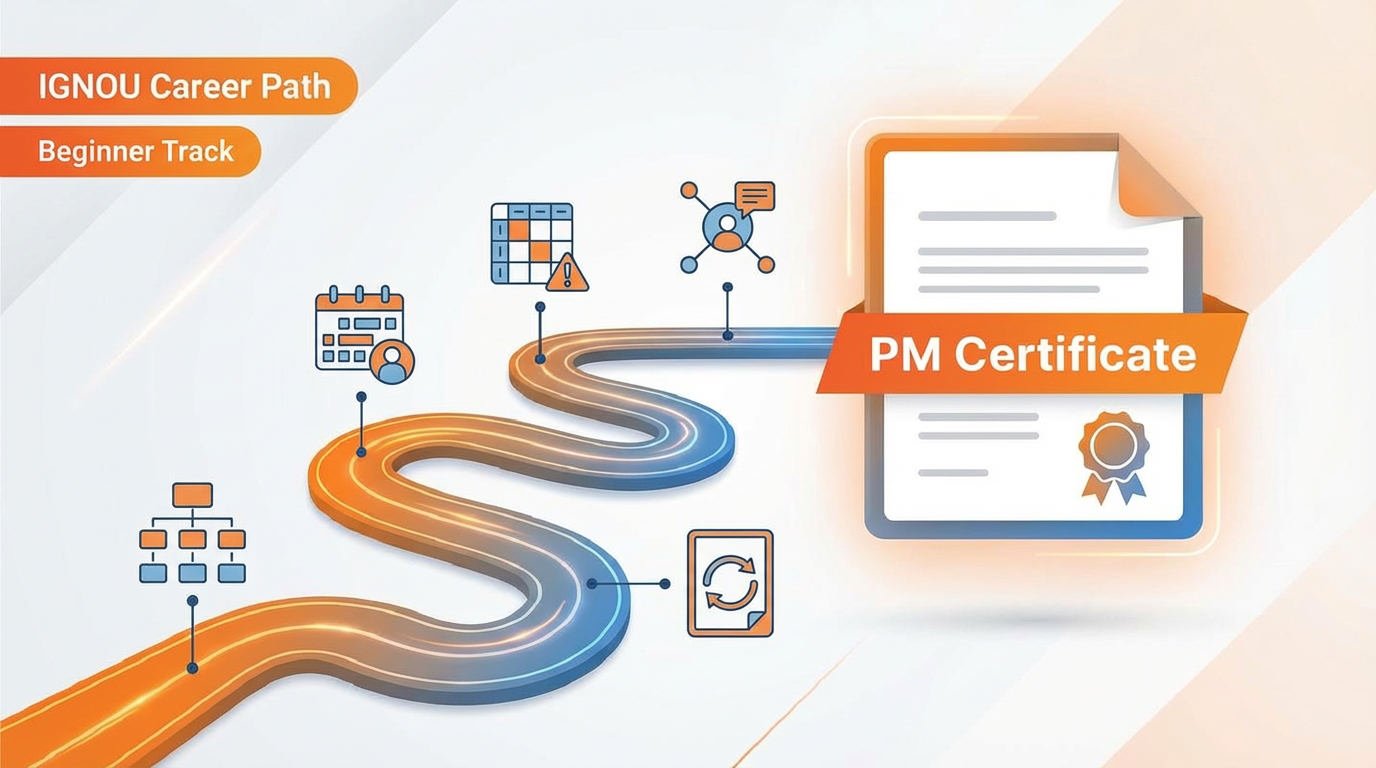
The simplest path that works for most people
The simplest path that works for most beginners
-
Pick one foundation credential
Choose Google, IBM, or Microsoft as your spine program (do not do all three).
-
Publish the PM Proof Pack
Create a single folder with: Charter, Stakeholders + RACI, Schedule, RAID log, and 2 sample status updates.
-
Learn one tool
Pick Jira (agile/tech) or MS Project/Smartsheet (corporate/ops) and replicate your plan inside the tool.
-
Publish one featured case study
Write a 1-page case study that links to all artifacts and highlights your decisions, trade-offs, and lessons learned.
-
Apply with proof
Target Project Coordinator / PMO Assistant / Junior PM roles and use your portfolio link in every application.
Project Management Career Path (Beginner) — Track 1
A structured entry path into project delivery roles. Pick one foundation certificate (Google/IBM/Microsoft), publish a PM Proof Pack, learn one tool (Jira or MS Project/Smartsheet), and create a featured case study you can share in interviews.
Fast facts
- Level: Beginner (no experience required)
- Time: Fast 6–8 weeks • Standard 10–14 weeks • Busy 4–6 months
- Weekly effort: 3–15 hrs/week (depends on pace)
- Core output: PM Proof Pack + 1 featured case study
- Tools: Sheets/Excel, Docs + (choose one) Jira or MS Project/Smartsheet
- Target roles: Project Coordinator, PMO Assistant, Junior PM
Jump to
Who this is for
- IGNOU learners and early-career professionals who want a structured, beginner-friendly entry path into project delivery roles.
- Students who prefer practical proof (charter, schedule, RAID/risk register, stakeholder updates) instead of theory-only learning.
- Career switchers targeting entry roles such as Project Coordinator, PMO Assistant, Junior Project Manager, or Delivery Coordinator.
- Agile-curious beginners who want a simple Agile add-on (backlog + sprint plan) without becoming a full-time Scrum specialist yet.
Time required (realistic estimates)
This roadmap is flexible. Most beginners finish the core path by focusing on one foundation credential + a small portfolio pack.
- Fast track: 6–8 weeks (10–15 hrs/week) — finish foundation learning + publish Proof Pack + 1 tool basics.
- Standard pace: 10–14 weeks (6–10 hrs/week) — most students and working learners.
- Busy schedule: 4–6 months (3–5 hrs/week) — steady progress without burnout.
Optional add-ons (if you choose them)
- UCI specialization (deepening): +6–10 weeks
- CAPM prep + exam readiness: +4–8 weeks
- Second tool (not recommended for beginners): +2–4 weeks
Outcomes (what you can do after this path)
- Create a clear Project Charter with scope, success metrics, assumptions, and constraints.
- Identify stakeholders and responsibilities using a Stakeholder Register and RACI.
- Build a simple project plan (scope/WBS outline + milestones + basic budget assumptions).
- Maintain a practical RAID log to track risks, issues, assumptions, and dependencies.
- Produce consistent weekly status updates that communicate progress, blockers, and next steps.
- Apply basic Agile delivery by creating a backlog, writing user stories, and planning one sprint.
- Publish a featured case study that links your artifacts and demonstrates decision-making.
- Apply confidently to entry roles such as Project Coordinator, PMO Assistant, or Junior PM with proof-of-work.
Prerequisites
- No prior experience required: beginner-friendly.
- Basic English reading/writing: most foundation certificates are taught in English.
- Laptop/PC + stable internet: for course videos, templates, and tool practice.
- Willingness to publish proof: you’ll create a small portfolio pack (charter, plan, RAID, status updates, case study).
Tools you’ll use
- Spreadsheets: Google Sheets or Microsoft Excel (planning tables, RAID log, simple schedule).
- Docs: Google Docs or Microsoft Word (charter, stakeholder notes, case study write-up).
- Slides (optional): Google Slides or PowerPoint (simple portfolio presentation).
- Project tool (choose one): Jira (agile/tech) or MS Project/Smartsheet (corporate/ops).
- Portfolio home: Notion / Google Drive folder / a simple webpage (one place to share all artifacts).
Roadmap
Step 1: Foundation credential (job-ready baseline)
Choose ONE foundation spine program to learn the full project lifecycle and generate job-ready portfolio evidence.
- Option A (most popular): Google Project Management Professional Certificate (Coursera)
- Option B (good alternative): IBM Project Manager Professional Certificate (Coursera)
- Option C (enterprise-leaning): Microsoft Project Management: Build Job-Ready Skills (Coursera)
Deliverable: a PM Proof Pack (charter + stakeholder/RACI + schedule + RAID/risk log + status reporting + agile backlog + featured case study).
Recommended courses (optional, guided learning)
If you prefer a guided course format, tool walkthroughs, or structured practice, use the curated options below.
Step 2: Core PM skills deepening (optional, high value)
Strengthen planning depth (scope/WBS, scheduling, budgeting, risk, procurement concepts) with a university-style specialization.
- Recommended specialization: Project Management Principles and Practices (UCI – Coursera)
Deliverable: an improved Planning Pack + stronger interview stories focused on trade-offs, governance, and delivery realism.
Step 3: First formal certification (optional for beginners)
If you want a recognized credential early, target CAPM (PMI) after completing your foundation learning.
- CAPM (PMI): Certified Associate in Project Management (CAPM)
- Eligibility (overview): secondary degree + 23 hours of project management education before the exam.
Deliverable: CAPM exam readiness + a credential to strengthen entry-level applications.
Step 4: Tooling (choose ONE based on target jobs)
Pick one tool track and build your plan inside it (board/plan + basic reporting). This is what makes your portfolio look “real.”
- Option A (Agile/tech teams): Jira fundamentals
- Option B (Corporate/operations): Microsoft Project fundamentals
- Option C (Cross-functional ops): Smartsheet fundamentals
Deliverable: one working tool workspace that produces weekly stakeholder-ready reporting.
Step 5: Upgrade path (when eligible)
Once you’re job-active, pick your long-term credential branch based on experience and role targets.
- PMP (PMI):
Project Management Professional (PMP)
Choose this when you meet PMI’s experience eligibility (commonly ~3–5 years depending on degree). - Scrum Master branch (PSM I):
Professional Scrum Master I (PSM I) – Scrum.org
Best if you target Scrum Master / agile delivery roles. - Agile practitioner branch (PMI-ACP):
PMI Agile Certified Practitioner (PMI-ACP)
Experience-based agile credential (intended for practitioners with agile experience).
Deliverable: a clear upgrade plan (and later, a senior credential) once you are experience-qualified.
Portfolio (Beginner Proof Pack)
Keep your portfolio simple: one featured project + 6 core artifacts. This is enough for entry-level PM interviews.
1) Featured Case Study (1 page)
- Problem & goal (with success metrics)
- What you planned, how you ran delivery, and what you learned
- Links to the artifacts below
2) Core PM Artifacts (6 items)
- Project Charter (1–2 pages)
- Stakeholder Register + RACI (1–2 pages total)
- Scope + WBS (simple deliverables + breakdown)
- Schedule (milestones or Gantt with 10–20 tasks)
- RAID Log (risks, assumptions, issues, dependencies)
- Status Report (template + 2 sample weekly updates)
3) Optional Agile Add-on (only for Agile/tech roles)
- Backlog (15–25 items)
- User stories (8–10 with acceptance criteria)
- 1 sprint plan + 1 retro summary
Portfolio Rubric (Quick Self-Check)
Use this checklist to validate your portfolio. If you can tick most items, your portfolio is interview-ready.
Featured Case Study (1 page)
- Clear problem + goal (in 2–3 sentences)
- Success metrics are measurable (time/cost/quality/scope)
- Shows decisions/trade-offs (not just documents)
- Links to each artifact (charter, plan, RAID, status, etc.)
- Ends with 3–5 lessons learned
1) Project Charter
- Scope is clear (what’s in / out)
- Success criteria are measurable
- Assumptions + constraints are listed
- High-level timeline and key milestones included
2) Stakeholders + RACI
- Key stakeholders listed with influence/interest (or priority)
- Owners are clear (who approves, who executes)
- RACI is realistic (not everyone is “Responsible”)
3) Scope + WBS
- Deliverables are broken down into workable tasks
- Tasks are specific enough to schedule and assign
- Major dependencies are visible
4) Schedule (Milestones or Gantt)
- 10–20 tasks with dates or durations
- Key milestones are highlighted
- Dependencies make sense (what must happen first)
- Includes a simple buffer for risks/unknowns
5) RAID Log (Risks, Assumptions, Issues, Dependencies)
- At least 8–12 items total
- Each item has an owner and next action
- Top risks have mitigations (what you will do)
- Issues include a clear status (open/closed)
6) Status Reporting
- Template includes: progress, next steps, blockers, risks, decisions needed
- At least 2 sample weekly updates completed
- Updates match the schedule (no contradictions)
Optional Agile Pack (only for Agile/tech roles)
- Backlog has 15–25 items and is prioritized
- 8–10 user stories include acceptance criteria
- One sprint plan includes a sprint goal + committed items
- Retro summary includes 2–3 improvement actions
Final “Interview Ready” Test
- You can explain the project in 90 seconds
- You can explain your top 3 risks and how you handled them
- You can show one example of stakeholder communication
- All artifacts are in one folder and share the same project name
Proof-of-work templates
Use these mini-templates to package your beginner PM Proof Pack for resumes, portfolios, and interviews. Fill the inputs, then copy the output.
Resume bullet builder (Project Coordinator / Junior PM)
Fill these inputs:
- Project: [college project / event / ops improvement / volunteer project]
- Scope: [what you delivered in 1 line]
- Artifacts: charter + stakeholders/RACI + schedule + RAID + 2 status updates
- Outcome: [on-time / reduced last-minute issues / clearer tracking / better stakeholder alignment]
Copy/paste output:
Planned and coordinated [project] by drafting a project charter, mapping stakeholders/RACI, building a milestone schedule, and maintaining a RAID log; delivered weekly status updates to [stakeholders], improving [visibility/predictability] and achieving [outcome].See a real example
Planned and coordinated a student workshop for 120 attendees by drafting a charter, mapping stakeholders/RACI, building a milestone schedule, and maintaining a RAID log; sent weekly updates to speakers and logistics leads, reducing last-minute changes and improving delivery visibility.
Featured case study (1 page)
Rule: Keep it scannable. A hiring manager should understand it in 60 seconds.
Copy/paste output:
Project: [name]
Goal: Deliver [outcome] by [date]. Success = [metric 1], [metric 2].
Scope: In-scope [A/B/C]. Out-of-scope [X/Y].
Plan: Charter + Stakeholders/RACI + Schedule + RAID + weekly status cadence.
Execution: [how you tracked progress] + [how you handled issues].
Key risk: [risk] → mitigation: [action].
Result: [what happened]. Lessons learned: [1–2].
See a real example
Project: College fest registration system.
Goal: Launch registration by 15 Dec; success = 500 sign-ups + zero downtime.
Plan: Charter + RACI + milestone schedule + RAID + weekly status updates.
Risk: vendor delay → prepared fallback form + earlier approvals.
Result: launched on time; 620 sign-ups. Lesson: lock dependencies earlier.
Interview answer (30–45 seconds)
How to use: Read once, then speak naturally (don’t memorize word-for-word).
Copy/paste output:
I managed a [project] where the goal was [outcome] by [date].
I created a simple PM Proof Pack: charter, stakeholders/RACI, milestone schedule, and a RAID log.
I ran a weekly routine: update schedule, update RAID, and send a status update with blockers and decisions needed.
The main challenge was [challenge], so I [action] to keep delivery on track.
We achieved [result], and the main lesson I learned was [lesson].
See a real example
I managed a student workshop project to deliver a 120-attendee event by a fixed date. I created a charter, stakeholder/RACI list, milestone schedule, and RAID log. Each week I updated the plan and sent a short status update with risks and decisions needed. A speaker drop-out risk appeared, so I confirmed a backup speaker and updated the schedule. We delivered on time and exceeded attendance; my main lesson was to pre-plan backups for critical dependencies.
Recommended Courses (Optional, Guided Learning)
Use these if you prefer a structured course format, tool walkthroughs, or guided practice. The roadmap itself is evidence-led—your goal is to produce portfolio-ready artifacts, not just finish videos.
Foundation spine (pick ONE)
Google Project Management Professional Certificate (Coursera)
Best “foundation spine” for most beginners: covers the full project lifecycle and includes guided practice plus a capstone-style project.
IBM Project Manager Professional Certificate (Coursera)
Strong alternative foundation spine. Choose this if you prefer IBM’s teaching style or want another well-known brand pathway.
Microsoft Project Management: Build Job-Ready Skills (Coursera)
Good foundation option if you want an enterprise-leaning track and expect to work in Microsoft-heavy workplaces.
Planning depth (optional, high value)
Project Management Principles and Practices (UCI – Coursera)
Optional deepening after your foundation: strengthens planning depth (scope/WBS, scheduling, budgeting, risk, and procurement concepts) to improve your Planning Pack and interview stories.
Tool track (choose ONE and build a real workspace)
Jira and Scrum Fundamentals for Beginners (Udemy)
Practical Jira basics for entry PM roles: boards, backlogs, sprints, and simple reporting. Ideal if you target agile/tech teams.
Common Beginner Mistakes (and how to avoid them)
1) Collecting certificates instead of producing proof
Fix: publish a small portfolio pack (charter, plan, RAID, status report, case study). Employers hire proof-of-work, not course completion.
2) Starting with PMP prep too early
Fix: begin with a foundation credential + portfolio. PMP is experience-gated; do it when you have real project leadership experience.
3) Writing vague scope and success criteria
Fix: make “done” measurable (dates, deliverables, quality criteria). Always include “in-scope” and “out-of-scope.”
4) Overplanning (huge documents nobody reads)
Fix: keep artifacts lightweight: 1–2 pages for charter, a simple schedule, a practical RAID log. Clarity beats volume.
5) Ignoring stakeholders and communication
Fix: create a stakeholder list + simple cadence (weekly status update). Many entry PM roles are primarily coordination and communication.
6) No “operating system” for execution
Fix: use a weekly routine: update schedule → update RAID → send status → log decisions. Consistency is the skill.
7) Treating Agile as vocabulary, not practice
Fix: create a backlog, write user stories, plan one sprint, write a retro with actions. One real sprint plan beats 20 definitions.
8) Not tailoring the path to target roles
Fix: pick a target role (Project Coordinator vs Agile delivery) and choose one tool accordingly (Jira or MS Project/Smartsheet).
9) Weak portfolio presentation
Fix: create one “featured case study” page and link every artifact. Make it easy for recruiters to scan in 60 seconds.
10) Applying without interview stories
Fix: prepare 5 STAR stories: scope change, risk issue, stakeholder conflict, timeline slip, and one agile sprint example.
Why Students Choose This Career Path
1) It is designed for “no experience” beginners
You start with a structured foundation program (Google/IBM/Microsoft) that teaches the full project lifecycle in a beginner-friendly way.
2) It produces proof-of-work, not just a certificate
Students can build a simple portfolio pack (charter, plan, RAID, status updates, agile backlog) that demonstrates real PM skills to recruiters.
3) It fits college schedules
The roadmap is modular. You can complete the foundation step at your own pace and add optional upgrades only if needed (UCI specialization, CAPM).
4) Clear next steps (no confusion)
The path tells you exactly what to do after the foundation credential: publish a portfolio, learn one tool, then choose CAPM now or PMP later when eligible.
5) It matches common entry-level roles
Project Coordinator, PMO Assistant, and Junior PM roles mainly require planning basics, documentation discipline, and communication—this path focuses on those hiring signals.
6) It is flexible across industries
The same PM fundamentals apply in education, tech, marketing, operations, and events, so students can choose a project theme that matches their interests.
7) It reduces wasted effort
Beginners often jump into advanced prep (like PMP) too early. This path prevents that by building the right base first and timing certifications correctly.
FAQs (Beginner Project Management Career Path)
1) Is this path suitable if I have zero experience?
Yes. This path is built for beginners: you start with a foundation credential and focus on building a small portfolio pack that proves you can plan and run a project.
2) Do I need to complete Google PM specifically?
No. Step 1 lets you choose one foundation spine: Google, IBM, or Microsoft. Pick one based on your preference and then follow the same portfolio steps.
3) How long does the full path take?
Most students finish the foundation step in 2–6 months (depending on weekly time). Optional upgrades (UCI specialization, CAPM, tools) add extra time.
4) What jobs can I apply for after completing Track 1?
Typical entry roles include Project Coordinator, PMO Assistant, Junior Project Manager, Delivery Coordinator, and trainee project roles in operations/IT/marketing.
5) What is the most important thing to publish in my portfolio?
Your featured case study (one page) plus the core artifacts: charter, stakeholder register/RACI, schedule, RAID log, and two sample status updates. This is the fastest “proof pack.”
6) Should I do CAPM immediately?
Only if you want a formal credential early. Many beginners can get interviews with a strong portfolio first. CAPM can help, but it is optional.
7) When should I do PMP?
PMP is for experienced professionals. Choose it later when you meet PMI’s experience requirements. Track 1 is the correct starting point.
8) Do I need Jira or MS Project?
You should learn one tool. Pick Jira for agile/tech teams, or MS Project/Smartsheet for corporate/operations environments. Do not try to master everything at once.
9) Can I use college projects for my portfolio?
Yes. A small, realistic project is ideal. Choose one theme and use it consistently across your artifacts so the portfolio looks coherent.
Related learning paths
Next steps
Block your first 30-minute session this week and complete the Start Week 1 milestone.
Start Week 1